
No products in the cart.
Pricing Transparency in Modern Pokémon & One Piece Graded Cards
(Case Study Included – Sugar OP04-024 SP Beckett 10 English)
Pricing data referenced as of February 2026
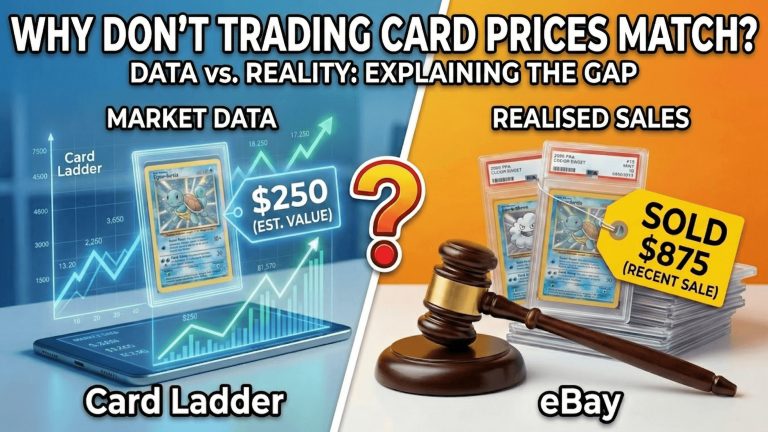
Two of the most popular pricing tools in the trading card hobby can show very different numbers for the same card. Neither is wrong, exactly. They are measuring different things. Understanding the gap matters for anyone buying or selling graded Pokémon and One Piece cards in 2026.
Imagine you have a graded Pokémon card. You look it up on the Card Ladder valuation platform and see a value of $124. Then you check eBay, where the same card in the same grade has been selling for $150 to $200. That is a meaningful difference, especially if someone is offering to buy the card based on the lower number.
And it's not a rare situation. It happens regularly with both Pokémon and One Piece graded cards, and it catches people off guard because they assume a price guide and a marketplace should agree. In practice, they often do not, and the reasons come down to how each platform collects and processes its data.
So where do Card Ladder and eBay get their numbers, why do gaps exist, and what does this mean for anyone looking to sell?
This article explains:
Important:
All pricing referenced in this article reflects publicly available sales data as of February 2026. Trading card markets are volatile and may have changed since publication.
All pricing referenced in this article reflects publicly available sales data as of February 2026. Trading card markets are volatile and may have changed since publication.
What is Card Ladder?
Card Ladder is a subscription-based price guide that tracks public sales of trading cards across multiple platforms. It pulls completed sale data from sources including eBay, Goldin, PWCC Marketplace and Heritage Auctions, then uses that data to generate an estimated market value for each card.
The platform was built primarily around sports cards, where sales volume is high and data is plentiful. It has since expanded to cover Pokémon, One Piece and other trading card categories. Card Ladder claims to track over 100 million historical sales going back to 2000.
The price you see on Card Ladder, known as the “CL Value,” is not simply the last price someone paid. It is a modelled estimate. Card Ladder anchors each card’s last sold price to a broader market index for that character or player, then adjusts the value daily as the index moves. The idea is to project what a card would sell for today, even if the most recent sale was weeks or months ago.
Each value also carries a confidence rating from 1 to 5. A recent sale means higher confidence. An older sale means the estimate is leaning more heavily on the index model and less on a real transaction.
Key features of Card Ladder:
- Tracks completed sales, not active listings or asking prices
- Aggregates data from multiple auction and marketplace platforms
- Converts international sales into local currency (AUD for Australian users)
- Filters outlier sales and uses trending averages rather than raw last-sold figures
- Requires a Pro subscription ($20/month or $200/year) for full access to data
Where Does Card Ladder Get Its Data?
Card Ladder aggregates completed sales data from major marketplaces and auction houses:
Key features of the platform:
For stable, high-volume markets (especially sports cards), this model performs well. However, modern TCG markets often behave differently.
What eBay shows you, and why it is different?
eBay is not a price guide. It is a marketplace where buyers and sellers set their own prices and transactions happen in real time. When you search for a card on eBay and filter to “Sold Items,” you see the actual amounts that real buyers paid on specific dates. No modelling, no indexing, no averaging. Just raw transaction data.
That directness is eBay’s strength as a pricing reference. It is also the reason its numbers often sit higher than Card Ladder’s estimates, particularly for cards in the Pokémon and One Piece categories.
How the two platforms compare at a glance:
| Card Ladder | eBay (Sold Items) | |
|---|---|---|
| What it shows | Modelled estimate based on historical sales and index trends | Actual completed sale prices from individual transactions |
| Data sources | eBay, Goldin, PWCC, Heritage Auctions | eBay only |
| Currency | Converts international sales to AUD | Shows sale currency (AUD on ebay.com.au, USD on ebay.com) |
| Outlier Handling | Filters outliers and averages across sales | Every sale visible, including outliers |
| Update Frequency | Recalculated Nightly | Real time as sales completed |
| Cost to Access | $20/mo or $200/year (Pro) | Free |
Why Card Ladder often shows lower prices for TCG cards
Card Ladder’s model works well for cards with high sales volume and frequent, consistent transactions. A PSA 10 Michael Jordan rookie that sells dozens of times a month will have a tight, reliable CL Value. The problem is that many Pokémon and One Piece cards do not trade at that volume, and the model was not originally designed for the way TCG markets behave.
Several factors push the CL Value below what sellers are observing in real transactions:
- Older sales drag the average down
When a card sells at $150 in November and then moves to $200 in January, Card Ladder’s index-weighted model can take time to catch up. The older, lower sale still carries weight in the estimate, especially if sales are infrequent.
- Language versions get blurred.
Card Ladder does not always separate English and Japanese printings cleanly. A Japanese version of the same card may trade at a different price point, and if both are feeding into the same index, the resulting estimate may not reflect what the English version is selling for on its own.
- Not all trades are captured.
High-grade collector cards frequently change hands through private sales, local shops and community groups that Card Ladder cannot see. This creates a narrower data set than the full market, and the sales that are captured may skew toward platforms where competitive bidding pushes prices differently.
- Low population cards lack data points.
If only a handful of copies of a card exist at a given grade, Card Ladder may be working from just one or two sales. A single below-market transaction can pull the estimate well below where the card would realistically trade today.
Case Study (February 2026): Sugar OP04-024 SP – Beckett 10 (English)
Card: Sugar OP04-024 SP (English)
Grade: Beckett 10
From the One Piece Card Game.
Public Sales Observed (January–February 2026)
Card Ladder Market Value (February 2026)
This represents nearly a threefold difference between modeled value and publicly observable sales.
To show how this plays out in practice, consider a graded card from the One Piece Card Game: Sugar OP04–024 SP in English, graded Beckett 10. Refer to the table above.
- In January and February 2026, publicly observable sales for this card painted one picture. Card Ladder’s estimate painted another. On eBay and public sales (Jan–Feb 2026), there were multiple sales with consistent selling prices well above $500 AUD.
- In Card Ladder though, a lower estimated value of around $224 AUD for Beckett 10 was being shown. This is because their data is drawn from aggregated historical sales and reflects older transactions that are still influencing the model.
The gap here is nearly double! That is not a trivial difference for a seller. Nor is it an isolated case.
This Is Not an Isolated Case
Similar discrepancies have been observed across:
In fast-moving TCG markets, especially graded cards:
When that happens, modeled averages may temporarily understate current clearing prices.
Why Card Ladder Can Show Lower Prices
The Transparency Question: The Paywall Issue
Card Ladder operates behind a subscription paywall. This means:
This does not invalidate the platform. However, it does create an information imbalance when Card Ladder is used as the sole authority during buying or selling discussions.
Best practice for transparency:
When referencing subscription-based tools, also provide publicly verifiable sold listings where possible.
Public marketplaces such as eBay allow buyers and sellers to independently confirm recent clearing prices.
Best practice for transparency:
When referencing subscription-based tools, also provide publicly verifiable sold listings where possible.
Public marketplaces such as eBay allow buyers and sellers to independently confirm recent clearing prices.
Proceed With Caution When Selling
If you are selling graded Pokémon or One Piece cards and a buyer references Card Ladder:
In modern TCG markets, relying solely on modeled averages may not reflect real-time value.
Retail Pricing vs Auction Pricing
Retail stores provide added value including:
Retail pricing may reasonably exceed auction comps.
The question for sellers is not whether a shop offer matches the eBay sold price, but whether the gap between the two is reasonable given the convenience being offered. Knowing the real market value from multiple sources puts sellers in a far stronger position to make that call.
The question for sellers is not whether a shop offer matches the eBay sold price, but whether the gap between the two is reasonable given the convenience being offered. Knowing the real market value from multiple sources puts sellers in a far stronger position to make that call.
Final Assessment (As of February 2026)
Markets move quickly. Modeled data can lag. Public sold listings remain essential for accurate valuation.
What does this mean for sellers?
Card Ladder is a useful analytical tool, especially for tracking long-term trends and comparing cards across grades. eBay sold listings are the closest thing the hobby has to a live market price. Used together, they give a fuller picture than either one alone.
The following steps will help sellers arrive at a fair picture of what their cards are worth:
- Check eBay sold listings from the past 30 to 90 days.
Filter to “Sold Items” (not active listings) and match the exact card, grade and language version. This is the most accessible, publicly verifiable data available.
- Cross-reference with Card Ladder if you have access.
Look at both the CL Value and the confidence rating. A low confidence score (1 or 2 out of 5) means the estimate is based on an older sale and should be treated as a rough guide rather than a firm number.
- Confirm the language version and grade.
English and Japanese printings trade at different prices. PSA 10 and Beckett 10 are not always valued identically. Make sure any comparison is apples to apples.
- Look at the population report.
If only a small number of copies exist at a given grade, pricing data will be thin and more volatile. Treat any single estimate with extra caution for low-population cards.
- Ask how the offer was calculated.
If a buyer or shop quotes a price, it is reasonable to ask what data they used. A transparent buyer will be happy to show their working. A Card Ladder number on its own, without supporting evidence from recent public sales, is not a complete picture.
For Pokémon and One Piece sellers in particular, the key takeaway is that Card Ladder’s estimates for TCG cards can sit below current market reality, especially for cards with low sales volume, recent price movement or mixed language data. Checking publicly available sold listings before agreeing to any offer is the single most effective thing a seller can do to protect themselves.
Disclaimer
All pricing referenced reflects publicly available sales data as of February 2026. Trading card values fluctuate, and current market conditions may differ at the time of reading.
Collectors and sellers should always verify the most recent sold listings before making financial decisions.
Frequently Asked Questions
Card Ladder uses a modeled market value based on weighted historical sales data. In rapidly repricing markets, recent price increases may not immediately be reflected in the model.
Card Ladder is legitimate, but in thin or volatile graded markets, pricing can lag behind current demand.
Yes. Older sales may still influence the displayed market value until enough new transactions shift the model.
Language segmentation can impact pricing. Differences between English and Japanese markets may affect averages.
It is recommended to review both subscription-based tools and publicly verifiable recent sold listings such as eBay to understand current market value.